
Top 100 Comeback Entrepreneurs Countdown
One entrepreneur per week for 100 weeks. Story. Score-style breakdown. Law of the Week. Operator application.
Follow us:

This Week’s Drop
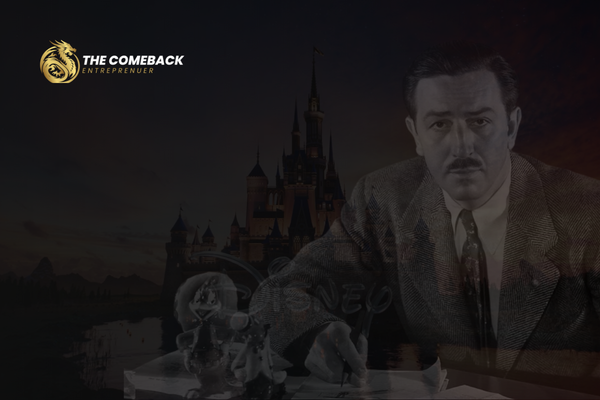
The Day Walt Disney Lost Everything and Built Something the World Had Never Seen
Comeback Chronicles | THE Top 100 Countdown
#95 Law 6: Innovation | Theme: Adapt Under Constraint
There is a moment in every serious entrepreneur's story where the floor disappears.
Not cracks.
Not weakens.
Disappears.
The contract is gone. The team is gone. The asset you built your entire business around belongs to someone else now.
Most people call that the end.
Walt Disney called it the train ride home.
And what he drew on that train ride became the foundation of the largest entertainment empire in history.
Not because he was the most talented animator of his generation.
Not because he had capital waiting, or a clear path forward, or the right connections in the right rooms.
Because when the floor disappeared, he stopped looking down at what was gone and started looking forward at what was still possible.
That shift, from loss to possibility, from constraint to instruction, is the entire lesson of Law 6.
And it is available to every operator reading this right now.
Why Most Entrepreneurs Fight Their Constraints Instead of Learning From Them
Before we get to Disney's story, let us name the pattern that keeps most operators stuck.
When a constraint appears, the instinct is to fight it.
To argue with it. To spend energy trying to remove it before taking any forward action.
Capital is tight, so you wait for funding before building. The market is not responding, so you wait for better conditions before refining. The team is not ready, so you wait for talent before executing.
Waiting feels strategic.
It is not.
Waiting is drift wearing the mask of patience.
The operators in the Top 100 did not wait for their constraints to be resolved before moving.
They moved because of the constraints.
They asked a different question than most entrepreneurs ask.
Not "when will this constraint be removed."
But "what does this constraint make available that was not available before."
That question is the engine of Law 6.
And Walt Disney's story is the most powerful proof that the question works.
The Business That Was Working, Right Until It Wasn't
In 1927, Walt Disney had something every young animator wanted.
A character the public loved. A distributor funding the work. A studio producing content that was selling.
Oswald the Lucky Rabbit was a hit.
Disney went to his distributor, Universal Pictures, to renegotiate his contract expecting better terms.
What he got instead was one of the most brutal lessons in the history of entertainment business.
Universal owned Oswald.
Not Disney.
In the contract he had signed without fully understanding the implications, the rights to the character belonged to the studio funding the distribution.
Disney's animators were recruited away.
His contract was not renewed on terms he could accept.
He walked out of that meeting with no character, no team, and no clear path forward.
Most people would have spent the next six months processing the loss.
Disney spent the train ride home creating the solution.
The Big Idea That Changes How You See Every Setback
Here is the uncomfortable truth most entrepreneurs never sit with long enough to understand:
Constraints do not just block paths.
They also reveal them.
When Oswald was taken, Disney's constraint told him something he could not have learned any other way.
It told him that building a business on an asset you do not own is not building at all.
It is borrowing.
And borrowed foundations collapse the moment the lender decides they want their asset back.
That insight, painful as it was, became the architectural principle of everything Disney built afterward.
He would own the characters. He would own the stories. He would own the distribution. He would build the infrastructure that protected the creative asset at every level.
Mickey Mouse was born on that train.
But more importantly, the operating principle that would govern the Disney empire was forged in that moment of complete constraint.
The loss did not just redirect Disney.
It instructed him.
And he listened.
The Moment Mickey Changed Everything
Mickey Mouse premiered in Steamboat Willie in November 1928.
What made it significant was not the character alone.
It was the technology.
Steamboat Willie was one of the first cartoons with synchronized sound.
At a time when most of the industry considered sound an expensive gimmick not worth the investment, Disney went all in.
Not from recklessness.
From pattern recognition.
The constraint of losing Oswald had taught him that operators who depend on systems they do not control are always one decision away from losing everything.
The technology constraint was teaching him the same principle from a different angle:
The operators who adapt to new tools before the rest of the market controls those tools control the next era.
He invested in synchronized sound when others would not.
He invested in color animation when others would not.
He invested in full-length animated films when the industry called it "Disney's Folly."
Every investment that looked like a risk was actually an adaptation to a constraint that others had decided to wait out.
Waiting was the real risk.
Moving was the leverage.
What the Setback Actually Built
Here is what Disney's constraint produced that his original strategy never would have:
First, it produced ownership as a non-negotiable business principle.
He never again built on an asset he did not control. Every character, every story, every park, every franchise was architected around ownership from the ground up.
Second, it produced the habit of early adoption.
Because he had learned that hesitation while others adapted meant losing position, he consistently moved toward new technology and new formats before the industry consensus caught up.
Third, it produced a system that compounded.
Mickey led to more characters. Characters led to merchandise. Merchandise led to the concept of a theme park. The theme park led to a media empire. Each innovation was built on the ownership principle the original constraint had forced him to learn.
The constraint did not just save Disney from a bad situation.
It installed the operating system that made every subsequent success possible.
The Enemy That Turns Constraints Into Dead Ends
Distraction says: focus on what was taken, not what is available.
Doubt says: this constraint means the market is telling you something about your capability.
Drift says: wait for the constraint to resolve before you build anything meaningful.
All three kept Disney's competitors stuck while he moved.
The animators who left with Oswald continued working within systems they did not own, producing content for studios that held the rights.
They were talented.
They were constrained by their own unwillingness to see the constraint as an instruction.
Disney saw it differently.
And the difference between those two perspectives is the difference between a career and an empire.
How This Law Applies to the Business You Are Running Right Now
The constraint you are currently facing is not Disney's constraint.
You are not losing a cartoon character to a distributor in 1928.
But the principle is identical.
Your capital constraint is telling you something about which part of your business model is too expensive to be sustainable at current revenue.
Your team constraint is telling you something about which processes need to be systematized so the business does not depend entirely on individual people.
Your market constraint is telling you something about which part of your positioning is unclear or misaligned with what buyers actually need.
Your time constraint is telling you something about which activities you are doing that do not compound and should be eliminated or delegated.
Every constraint contains an instruction.
The question is whether you are listening to the instruction or fighting the constraint.
Disney listened.
Here is how you do the same thing this week.
The 7-Day Innovation Protocol
Day 1: Name the constraint in one sentence.
Not the story around it. Not the history of how it developed. The constraint itself in one clean sentence.
"Right now, the constraint is ___."
Write it. Do not soften it. The constraint you cannot name clearly is the constraint you cannot adapt to.
Day 2: Ask the constraint one question.
"What route does this constraint make available that was not available before?"
Write one answer. Not the perfect answer. Just one honest answer. Disney's answer on the train was a mouse. It did not need to be perfect. It needed to be a start.
Day 3: Identify one asset you do not fully control.
A client relationship that lives entirely in one person's inbox. A platform algorithm that determines your reach. A single revenue source that, if it ended tomorrow, would change everything.
Name it. That is a constraint waiting to become a crisis. The time to address it is before the crisis forces your hand.
Day 4: Build one thing from what you currently have.
Not what you wish you had. Not what you used to have before the constraint appeared.
What you have right now.
Disney had a pencil and a train ride. He built Mickey.
What can you build today from exactly what is in front of you?
Day 5: Identify one tool or method you have been calling too early to invest in.
Disney called synchronized sound worth investing in before the industry agreed.
What is the equivalent in your industry right now?
Not the trend. The capability that the best operators in your space will be using seriously in two years.
Study it for one hour this week. That hour is more valuable than it looks.
Day 6: Enforce one ownership principle.
Where are you building on someone else's foundation?
A platform you do not own. A customer list you do not control. Intellectual property you have not protected. Revenue that depends entirely on a relationship you could lose.
Name one. Take one step this week to reduce that dependency.
Day 7: Score the adaptation.
Did the constraint teach you something this week?
If yes, write the instruction in one sentence.
If no, sit with the constraint for ten more minutes and ask the question again.
The instruction is almost always there.
Operators who find it are the ones who build something durable from what looked like a setback.
Three Standards That Protect You From Waiting Out the Wrong Constraints
Standard One: The constraint question.
Every time a significant constraint appears, before responding emotionally, write one sentence: "What is this showing me?" The answer is your innovation prompt. Never skip this step.
Standard Two: The ownership audit.
Once per quarter, list every asset your business depends on that you do not own or control. Prioritize reducing that list by one item each quarter. Ownership is not built overnight. It is built by removing one dependency at a time.
Standard Three: The early adoption check.
Once per quarter, ask yourself what capability the strongest operators in your space will be using seriously two years from now. Spend at least one hour studying it today. The operators who adapt early do not get lucky. They get there first because they started earlier.
What Walt Disney Actually Built
Disneyland opened in 1955.
Walt Disney World opened in 1971.
The Disney Company today encompasses theme parks, film studios, streaming platforms, merchandise, and intellectual property that generates revenue across more categories than most industries contain.
None of it traces back to Oswald the Lucky Rabbit.
All of it traces back to what the loss of Oswald forced Disney to understand.
Own the asset. Adapt before the market requires it. Build systems that compound rather than depend.
That is not an entertainment company story.
That is an operator story.
The constraint that felt like destruction in 1928 was actually the most valuable instruction Walt Disney ever received.
He just had to be willing to hear it on a train ride home with almost nothing left.
The question for you is simpler.
What is your current constraint trying to tell you?
And are you listening?
Comeback Score Snapshot: Walt Disney #95
Rank: #95 Comeback Score: 91 / 100 Theme: Constraint as instruction, ownership as architecture
This is not a money score.
It is not a net worth contest or a popularity ranking.
It measures the shape and durability of the comeback.
Where you started and what you had to work with. The depth of the loss and what it forced you to confront. The strength of the adaptation and whether it compounded over time. The repeatability of the system built from the constraint. The durability of the result across decades, not just quarters.
Disney scores high not because of what he built.
Because of the operating discipline he built it from.
A discipline that started on a train ride with a pencil and a constraint that had just taken everything.
The Comeback Entrepreneur's Journey: Where Do You Stand?
Every comeback has two journeys.
The outer journey is what happened. What you lost. What you rebuilt.
The inner journey is what shifted. What you finally owned. What standards you enforced when the easy move was to wait.
Most people study the story.
Operators rebuild the identity first.
That is the difference between inspiration and reversal.
If you want to know where you stand, take the Comeback Challenge.
It is not a personality quiz.
It is a scoreboard.
You will receive a 0 to 100 Comeback Score with a clear breakdown of where you are solid and where drift is quietly costing you momentum.
Takes 5 to 10 minutes. Results saved and emailed. If you qualify, you will see the next step.
Take the Comeback Challenge. Get Your Score.https://comebackentrepreneur.com/take-the-challenge





Copyright © 2026 The Comeback Entrepreneur.
SOCIAL


Facebook
Instagram
LinkedIn
Youtube