
Top 100 Comeback Entrepreneurs Countdown
One entrepreneur per week for 100 weeks. Story. Score-style breakdown. Law of the Week. Operator application.
Follow us:

This Week’s Drop
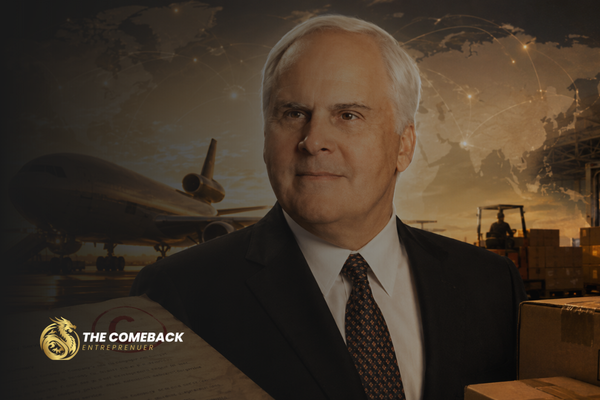
The Business Plan That Got a C. The Company That Changed the World.
Comeback Chronicles | THE Top 100 Countdown
#92 Law 9: Leadership | Theme: Leadership Begins When Excuses End
There is a story every entrepreneur needs to hear at least once.
Not because it is inspiring.
Because it is instructive.
Fred Smith wrote a paper at Yale University outlining a business model for overnight package delivery using a hub-and-spoke distribution system.
His professor gave it a C.
The feedback, as the story goes, suggested the concept was interesting but impractical.
Fred Smith did not argue with the grade.
He built the company anyway.
That decision, to lead from his own conviction rather than from the verdict of someone else, is the entire lesson of Law 9.
Leadership is not waiting for permission.
Leadership is not waiting for consensus.
Leadership is not waiting for the people in positions of authority to tell you that your vision is valid.
Leadership is the decision to move forward when every external signal says stop.
And Fred Smith made that decision repeatedly, under pressure that would have ended most operators before they got started.
Why Most Entrepreneurs Confuse Management With Leadership
Before we get to FedEx, let us name the trap that keeps most operators permanently stuck at the level of managing rather than leading.
Management responds to conditions.
Leadership creates them.
Management asks: what are the constraints?
Leadership asks: what is required despite the constraints?
Management waits for the path to be clear.
Leadership builds the path while moving.
Most entrepreneurs are exceptional managers.
They are efficient under good conditions.
They execute well when resources are adequate.
They perform consistently when the environment is stable.
But leadership is the thing that gets tested when conditions are bad, resources are inadequate, and the environment is anything but stable.
And that is exactly where Fred Smith's story begins.
The Idea That Experts Said Would Never Work
Smith's core insight was structural.
The existing package delivery system was built around point-to-point routes.
If you needed to send a package from Memphis to Seattle, it traveled along a chain of connections, each handoff introducing delay, error, and inefficiency.
Smith saw a different architecture.
Route everything through a central hub.
Sort it overnight.
Deliver it the next morning.
The concept required building an entire logistics infrastructure from scratch.
It required aircraft, sorting facilities, trucks, and technology that did not yet exist at the scale he envisioned.
It required capital that no rational investor would easily provide for an unproven model.
And it required a level of operational precision that had never been demonstrated in the delivery industry.
When experts looked at what Smith was proposing, they did not see a company.
They saw a list of reasons it would not work.
Smith saw a different list.
He saw the reasons it had to work.
And that gap, between what the critics saw and what the leader saw, is where every real comeback is born.
The Launch That Almost Killed the Company Before It Started
FedEx launched in 1973.
The early days were not a story of momentum building on momentum.
They were a story of survival.
The 1973 oil crisis hit almost immediately after launch, sending fuel costs to levels that threatened the entire operating model.
Capital ran out faster than projected.
Investors considered pulling out.
Employees went weeks without reliable paychecks.
Smith himself made a decision during one of the company's most desperate moments that has become one of the most retold stories in business history.
He flew to Las Vegas with the company's last $5,000 and played blackjack.
He came back with $27,000.
That money kept the lights on long enough to secure additional financing.
Most people tell that story as proof that Smith was a gambler.
The real lesson is different.
He understood that $5,000 was not enough to save the company through conventional means.
So he refused to let conventional thinking govern an unconventional situation.
That is leadership under constraint.
Not recklessness.
The refusal to let the limits of normal thinking define the boundaries of what is possible.
The Big Idea That Changes How You See Every Leadership Crisis
Here is the uncomfortable truth that most operators never fully absorb.
Leadership crises do not test your plan.
They test your identity.
When the fuel crisis hit FedEx, the plan became irrelevant.
The original financial projections were wrong.
The timeline was wrong.
The capital requirements were wrong.
Everything that Smith had projected was being overturned by reality.
What did not change was the identity behind the plan.
The conviction that the model was correct.
The commitment to the people who had joined the mission.
The refusal to let external pressure become internal permission to quit.
This is what separates leadership from management at the most fundamental level.
Management is a function.
Leadership is an identity.
And identity is what holds when everything else is falling apart.
The Structural Decision That Made FedEx Inevitable
Smith's leadership was not purely about conviction.
It was about structural thinking under pressure.
When the company was struggling, he did not respond by changing the vision.
He responded by getting more precise about the execution.
He identified which routes were profitable and which were bleeding cash.
He cut the unprofitable routes without sentiment.
He focused the operation on the core model and refused to dilute it with compromises that would have undermined the system's integrity.
He also fought for the regulatory changes that FedEx needed to operate at scale.
The Civil Aeronautics Board restricted cargo airlines in ways that threatened FedEx's model.
Smith lobbied aggressively for deregulation.
He did not accept the regulatory environment as a fixed constraint.
He treated it as a solvable problem.
This is the leadership pattern that the comeback entrepreneur needs to recognize.
Leaders do not just push through obstacles.
They change the architecture of the problem.
They identify which constraints are fixed and which are moveable.
Then they move the ones that can be moved while building around the ones that cannot.
What Leadership Actually Looks Like When the Room Goes Quiet
There is a moment in every serious entrepreneurial story that never makes the highlight reel.
It is the moment when the room goes quiet.
When the investors are skeptical.
When the team is looking at each other instead of at you.
When the numbers are telling one story and you are trying to tell another.
When everyone who is reasonable is suggesting you reconsider.
That is the moment leadership is either proven or abandoned.
Smith faced that moment multiple times in FedEx's early years.
Every time, he did the same thing.
He got clearer.
Not louder.
Not more defensive.
Not more aggressive.
Clearer.
He went back to the fundamental structural truth of the model and communicated it with enough precision and conviction that the people around him could either follow or leave.
Some left.
Most followed.
And the ones who followed built something that redefined what was possible in global logistics.
How This Law Shows Up In Your Business This Week
The version of this that applies to you is not about overnight delivery or hub-and-spoke logistics.
It is about the moment you are in right now.
The initiative that is stalling.
The team member who is waiting for you to be certain before they commit.
The investor or client who is watching to see whether you believe in what you are building.
The decision you keep postponing because you are waiting for the conditions to be better.
Leadership begins when excuses end.
Not when resources are adequate.
Not when the market cooperates.
Not when the team is fully aligned.
Not when the timing is right.
Leadership begins the moment you stop explaining why it is difficult and start deciding what to do about it.
Your move this week is simple.
Write down the one place in your business where you have been managing the situation instead of leading it.
Not executing around it.
Not explaining it to stakeholders.
Leading it.
What would the decision look like if you led instead of managed?
Make that decision this week.
The 7-Day Leadership Protocol
Day 1: Identify the place where you are managing instead of leading.
Write one sentence: "I have been managing this instead of leading it: ___."
Do not soften it. Do not explain it. Just name it.
Day 2: Separate the fixed constraints from the moveable ones.
Every situation has both. Most operators treat everything as fixed because it feels safer.
Write two lists. What cannot be changed. What can be changed if you lead toward it.
Day 3: Make the decision you have been postponing.
Not the comfortable decision. The leadership decision.
The one that requires you to commit to a direction before you have certainty.
Day 4: Communicate the direction to the people who need to follow it.
Not defensively. Not with excessive explanation.
With the clarity that comes from having actually decided.
Day 5: Remove one obstacle that has been treated as permanent.
Smith lobbied for deregulation. He did not accept the constraint as fixed.
What is the regulatory, structural, or operational constraint in your business that you have accepted as permanent but that could be challenged?
Challenge it this week.
Day 6: Identify the person on your team who is waiting for your leadership.
They are there. They always are.
Who is watching you to decide whether to commit fully?
Give them a clear direction today.
Day 7: Score the week like a leader.
Not: did everything go as planned?
But: did I lead, or did I manage?
Those are different questions. Answer the right one.
Three Standards That Protect You From Drifting Back Into Management Mode
Standard One: The decision audit.
Once per week, look at the three biggest decisions you made. Were they leadership decisions or management decisions? Leadership moves toward the vision. Management responds to the conditions.
Standard Two: The conviction check.
When you communicate direction to your team, are you communicating what the conditions allow or what the vision requires? Those are different conversations. Lead with the vision.
Standard Three: The obstacle classification.
Every time you face a constraint, classify it immediately. Fixed or moveable. If moveable, what is the leadership move that addresses it? Never accept a moveable constraint as fixed by default.
What Fred Smith Actually Built
FedEx today operates in over 220 countries and territories.
It processes millions of packages every single day.
It employs hundreds of thousands of people.
It operates one of the largest commercial aircraft fleets in the world.
None of that existed before Fred Smith decided that a C on a college paper was not a verdict.
None of it happened because conditions were favorable.
All of it happened because one person kept leading when every reasonable signal said it was time to stop.
That is the comeback lesson.
Not the logistics.
Not the hub-and-spoke system.
Not the aircraft.
The decision to lead from conviction rather than from the permission of others.
Law 9 says: leadership begins when excuses end.
Run the protocol.
Seven days. One leadership decision per day. Three standards enforced.
That is how operators stop managing their comeback and start leading it.
Comeback Score Snapshot: Fred Smith #92
Rank: #92 Comeback Score: 89 / 100 Theme: Leadership under impossible conditions, structural conviction over external validation
This is not a money score.
It is not net worth or revenue or popularity.
It measures comeback shape and durability.
Starting point: an unproven model, a skeptical market, and a C from a Yale professor. The constraint: fuel crisis, capital shortage, regulatory resistance. The adaptation: led from conviction, cut without sentiment, lobbied for structural change. The repeatability: built systems that could survive pressure without requiring the founder to be present in every decision. The durability: FedEx became the infrastructure that global commerce depends on.
The Comeback Entrepreneur's Journey: Where Do You Stand?
Every comeback has two journeys.
The outer journey is what happened. What you lost. What you rebuilt.
The inner journey is what shifted. What you finally owned. What standards you enforced when distraction, doubt, and drift showed up.
Most people study the story.
Operators rebuild the identity first.
That is the difference between inspiration and reversal.
If you want to know where you stand, take the Comeback Challenge.
It is not a personality quiz.
It is a scoreboard.
You will receive a 0 to 100 Comeback Score with a clear breakdown of where you are solid and where drift is quietly costing you momentum.
Takes 5 to 10 minutes. Results saved and emailed. If you qualify, you will see the next step.
Take the Comeback Challenge. Get Your Score. https://comebackentrepreneur.com/take-the-challenge





Copyright © 2026 The Comeback Entrepreneur.
SOCIAL


Facebook
Instagram
LinkedIn
Youtube