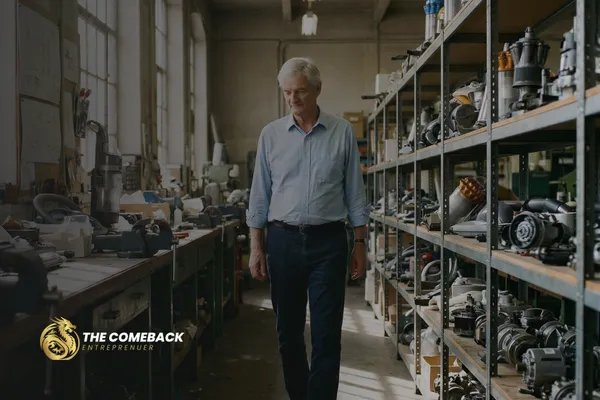
5,127 Failures Created The Only Proof The Market Respects
Comeback Chronicles | THE Top 100 Countdown
#100 James Dyson | Law 1: Faith, Conviction Before Evidence
If you’ve been in business long enough, you know this feeling:
Things aren’t broken, but they’re not moving either.
You’re working, decisions are being made… but progress has slowed.
So when progress stalls, it does not feel like confusion. It feels like friction in your identity. Decisions that used to feel sharp start to feel heavy. The inputs multiply. The noise gets louder. You add tools, tactics, and options, thinking clarity will show up.
Then you look up and realize something uncomfortable.
You stayed busy, but nothing really advanced.
That’s how drift actually shows up in a business.
Not with one catastrophic failure, but with small standards that stop being enforced. Distraction fragments focus. Doubt delays execution. Drift quietly lowers the bar.
This is why the first story in Comeback Chronicles is about James Dyson.
Not because he built a vacuum.
But because his approach is something every operator can use: staying committed before the results show up.
Five years.
5,127 prototypes.
That number is not trivial. It is the standard.
The “Normal” Problem That Was Quietly Profitable
Dyson’s story begins with a problem most people accept as normal.
A vacuum that loses suction.
The bag clogs, suction fades, performance drops, and the industry’s built-in solution is predictable: buy more bags, replace them, keep feeding the system.
Most people complain, then comply.
Dyson did the operator move. He noticed the incentives.
When a product’s flaw generates repeat purchases, that flaw often becomes part of the business model. Not because anyone is evil, but because incentives shape what gets protected.
That observation matters far beyond vacuums.
Real estate operators see it in bad property management that keeps owners dependent.
Agency founders see it in marketing fluff that keeps clients confused.
Trades owners see it in “quick fixes” that guarantee repeat service calls.
AI and automation leaders see it in tool churn that creates more complexity than leverage.
Advanced operators see it in internal standards slipping because the machine still turns a profit.
The pattern is the same:
A system can stay imperfect for a long time if the imperfection is profitable.
Dyson was not motivated by inspiration. He was motivated by a standard.
“This should work better than it does.”
The First Breakthrough That Could Have Ruined Everything
Dyson saw cyclone separation used in industrial environments to pull dust from air. He built a crude cyclone prototype by removing the vacuum bag and replacing it with a cyclone system.
It worked.
That moment is where many founders lose the plot.
They treat “it worked once” as the win. They rush to pitch. They rush to brand. They rush to make it a story.
A working prototype isn’t the product.
The real test is whether it holds up in the real world.
Real life means:
manufacturing constraints
costs that force tradeoffs
components that fail under daily use
users who do not follow instructions
performance that must hold up without perfect conditions
A comeback does not get built when something works one time.
A comeback gets built when the operator keeps refining long enough for reality to stop arguing.
The Five-Year Tunnel That Makes Most People Quit Quietly
Dyson’s five years and 5,127 prototypes are where the real story begins.
Because that is what repeated rejection feels like.
It wasn’t one big failure.
It was thousands of small ones, stretched over years.
Outer pressure looks like:
time passing
money tightening
manufacturers hesitating
gatekeepers delaying
skepticism from people who mean well
constant friction and technical failures
Inner pressure is worse.
The harder part isn’t the external setbacks; it’s what they start doing to your confidence over time.
Rejection does not just say, “This version is not good enough.”
Rejection tries to whisper, “You are not good enough.”
That is when capable entrepreneurs start making emotional exits dressed up as strategy.
They do not quit publicly. They lower the standard privately.
They start “resetting” instead of refining.
New offer.
New positioning.
New platform.
New tool stack.
New idea.
Sometimes that is a strategy.
Often, it is pain avoidance.
Starting over feels easier. Refining forces you to confront what’s not working.
Dyson stayed exposed.
Not because he enjoyed it.
Because he had a standard, and he refused to negotiate with it.
Why The Gatekeepers Said No
A bagless vacuum is not just a better vacuum. It threatens the category’s economics.
Bags are recurring revenue. Bagless removes that stream.
So when Dyson approached established manufacturers and players, he was not just asking them to adopt an innovation. He was asking them to disrupt their own replacement economy.
This is a key comeback lesson for operators.
Not every rejection is about quality.
Some rejection is about incentives.
If your move threatens how someone else gets paid, their default response is resistance, even if your product is better.
So the operator’s job is to diagnose rejection correctly:
If the rejection is because your system is weak, refine.
If the rejection is because incentives are threatened, build leverage and change the route.
Most entrepreneurs fail at that diagnosis. They take resistance personally, then drift.
Dyson used resistance as a map.
The Side Door That Bought Oxygen
When the primary gate stayed closed, Dyson found a side door.
Japan.
His cyclone vacuum was first sold in Japan as the G-Force, positioned as a premium product. It gained recognition and traction that created something Dyson needed more than applause.
Runway.
Oxygen.
Time to keep refining.
This pattern repeats across industries:
When the mass market resists, go upmarket.
When broad positioning creates confusion, go narrow.
When distribution gates are blocked, go direct.
When incumbents resist, find a segment that values the improvement more and will fund the build.
The key is not luck.
The key is refusing to abandon the standard.
You change the route, not the mission.
The Decision That Changed Everything
Eventually, Dyson did what many founders delay far too long.
He stopped waiting for permission.
He built the company.
That is the real turning point of the story.
Not the day the product became popular.
The day he chose ownership over approval.
This is where Law 1 becomes real.
Faith is not a feeling. Faith is not loud confidence.
Faith is a disciplined conviction before evidence.
Faith is the calm decision to keep building while the scoreboard is silent.
The “Overnight” Win The World Finally Noticed
In 1993, Dyson began production of the DC01. That is the moment the public can point to.
But the comeback was not built in 1993.
What looked like an overnight success in 1993 was actually the result of years of iteration no one saw.
This is why Dyson belongs in Comeback Chronicles.
Because the lesson is not “be inspired.”
The lesson is structural:
Treat rejection as incomplete refinement, not identity.
Keep standards steady while outcomes fluctuate.
Find oxygen through a side door when gatekeepers stall.
Build leverage and ownership rather than waiting to be chosen.
Convert repeated failure into a repeatable process.
That is comeback architecture.
Law 1: Faith, Defined For Operators
Faith, in Comeback Chronicles, is not a motivational language.
It is an operational language.
Faith is disciplined conviction before evidence.
Faith shows up as behavior:
You keep the standard steady while outcomes lag.
You refine one variable at a time instead of rebuilding emotionally.
You do not outsource your identity to market feedback.
You stay in the arena long enough for skill and proof to compound.
Faith defeats the enemy stack.
Distraction loses to structure.
Doubt loses to evidence.
Drift loses to enforced standards.
Now the only question is: what do you do this week?
The Dyson Protocol For Turning “No” Into Proof
Here is the move. Not theory. Not inspiration. A protocol.
The 7 Day Faith Protocol
1) Pick one arena where rejection is happening
Choose one, not three:
Sales calls
Outreach
Offer conversion
Content response
Hiring
Operations bottleneck
Deal flow
Capital raising
Define the problem clearly in one sentence:
“Right now, this part of my system isn’t working.”
That is not a weakness. That is clarity.
2) Lock the constraint for seven days
For seven days, no rebrand. No platform jump. No emotional reset.
Just focus on improving what’s already in motion.
Starting over feels clean. Refining builds proof.
3) Run one iteration per day, one variable at a time
Examples:
Change the first line of your outreach message.
Tighten the offer, remove one confusing option.
Adjust the call structure to control the close.
Improve the qualification filter so you stop bleeding time.
Tighten the follow up cadence and measure response.
Change the hook that starts the conversation.
Make one change at a time, and measure the result.
Avoid changing multiple variables at once.
4) Track two numbers, nothing else
Daily, for seven days:
Attempts made
Feedback gathered
This prevents drift because it removes emotion from the decision loop.
5) Decide on Day 7 like an operator
If the signal improved, double down.
If the signal is mixed, refine again.
If the signal stays dead, kill it cleanly and pick the next arena.
Faith is not stubbornness forever.
Faith is refusing to quit before you have executed a real refinement cycle.
The Three Protections That Keep You From Sliding Back Into Drift
This week’s Law only works if it gets enforced.
Use these three protections for the next seven days.
Protection 1: The Two Hour Build Block
Every day, schedule one two-hour block that produces evidence.
Evidence is output that moves the metric. Not planning. Not organizing. Not tool shopping.
Name your evidence output, then protect it.
Protection 2: The Evidence Log
At the end of the build block, write two bullets:
What improved today?
What did I learn today?
Doubt grows in vagueness. Evidence kills vagueness.
Protection 3: The Standard Audit
Once this week, answer these in writing:
What standard slipped?
What must be refined?
What decision am I avoiding?
Choose one correction and enforce it for seven days.
One correction. Enforced. That is how standards return.
Weekly Wrap: What To Take From #100
Dyson’s comeback is not a feel-good story. It is a discipline story.
5,127 prototypes is what conviction looks like when nobody is clapping.
Law 1 is Faith because the real threat is not failure.
The real threat is what failure tries to do to your identity.
So run the protocol.
Seven days. One arena. One iteration per day. Two numbers tracked. One decision at the end.
That is how comebacks restart motion.
Comeback Score Snapshot, #100 James Dyson
Rank: #100
Comeback Score: 43 / 100
Theme: Persistence outlasts rejection
What does that score actually mean?
It is not about money.
It is not a revenue leaderboard.
It is not a net worth contest.
It is not a popularity ranking.
It is a comeback scoreboard.
The score reflects how strong and sustainable your comeback process is.
Your starting point, what you had to work with.
The lows, setbacks, failures, rejections, and pressure you endured.
The highs, breakthroughs, and whether you kept compounding after wins.
The repeatability, whether you built a system that survives setbacks without resetting every time life hits.
The durability, whether the comeback holds over time, not just for one moment.
A person can earn a lot of money and still have a weaker comeback profile if they never had to rebuild, never faced repeated failure, or never proved resilience under pressure.
Another person can have a smaller financial outcome and score higher if their path required multiple reversals, identity stability, and repeated rebuilding with enforced standards.
This is why the scoreboard exists.
Not to impress you.
To reveal where you are solid, and where drift is quietly costing you momentum.
The Comeback Entrepreneur’s Journey (And Where You Stand)
Every comeback has two journeys.
The Outer Journey is what happened. What you lost. What you rebuilt.
The Inner Journey is what shifted. What you owned. What standards you enforced when distraction, doubt, and drift showed up.
Most people study the story.
Operators rebuild the identity first.
That’s the difference between inspiration and reversal.
If you want to know where you stand, take the Comeback Challenge.
It’s not a personality quiz.
It’s a scoreboard.
You’ll receive a 0 to 100 Comeback Score with a breakdown of where you’re solid, and where drift is quietly costing you momentum.
The score is based on your comeback profile, not your income. It reflects your starting point, the lows and highs you have navigated, and how well you have built a repeatable system that survives setbacks instead of resetting every time pressure hits.
It takes 5 to 10 minutes.
Results are saved and emailed.
If you qualify, you’ll see the next step.
