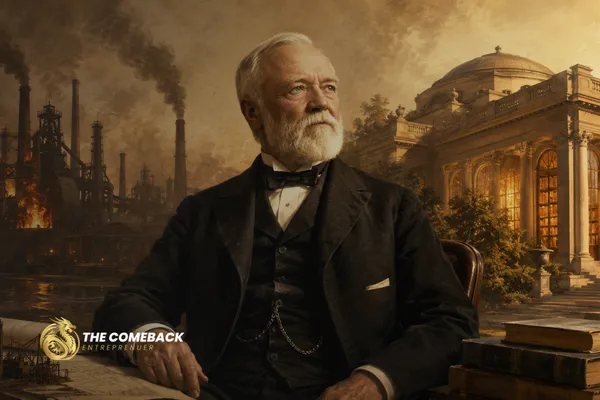
He Sold the Steel Empire. What He Built Next Has Lasted 120 Years.
Comeback Chronicles | The Top 100 Countdown
#89 Law 12: Legacy | Theme: Build Something That Outlives the Season
Andrew Carnegie built the largest steel empire in American history and then walked away from all of it. What he built next is still operating today. That is not a coincidence. That is Law 12.
In 1901, Andrew Carnegie sold Carnegie Steel to J.P. Morgan for $480 million, the equivalent of roughly $17 billion today.
He was 65 years old.
He had spent four decades building, acquiring, consolidating, and compressing an entire industry into a machine that produced more steel than all of Great Britain. He had done what no one else had done at that scale. He had won.
And then he stopped.
Not because he was tired. Not because he was forced out. Not because the market turned.
He stopped because he had decided, decades earlier, what his empire was actually for.
And it was not for him.
The Decision That Preceded the Empire
Most people know Carnegie as the steel baron. What most people do not know is that Carnegie made a decision about legacy before he made his fortune.
At 33 years old, still early in his career, already successful but nowhere near the wealth that was coming, Carnegie wrote a memo to himself. A personal note he never intended anyone to see.
In it, he wrote that he planned to spend the first half of his life accumulating wealth, and the second half giving it away. He wrote that a man who dies rich dies disgraced.
That was not a marketing statement. It was an operating doctrine written in private at 33, and honored in full at 65.
The systems he built to give away his wealth: 2,509 libraries across the world, the Carnegie Institution, the Carnegie Endowment for International Peace, Carnegie Mellon University, and dozens of other institutions. These were not built after he sold the company.
They were designed in parallel. They were the point.
Most operators build a business and then wonder what it was for.
Carnegie decided what it was for first, and built the business around that answer.
That is the Law of Legacy. And it is the law that separates a comeback from a contribution.
Why Legacy Is Not What Most Entrepreneurs Think It Is
When most operators hear the word legacy, they picture a monument.
A building with their name on it. A Wikipedia page. Recognition that outlasts them.
That is not legacy. That is vanity with better branding.
Legacy is a mechanism, not a monument.
It is the system you build that continues to produce the outcome you cared about after you are no longer in the room.
Carnegie's legacy is not the steel. Nobody uses Carnegie steel anymore. The empire he spent four decades building is gone. The industry itself looks nothing like it did in 1901.
What is still running are the libraries. The universities. The foundations. The frameworks for how wealthy individuals think about the responsibility of capital.
Those are mechanisms. They operate without him. They produce outcomes he cared about, the elevation of ordinary people through access to knowledge and opportunity, without requiring his presence.
That is legacy. A system that outlives the season.
The Operator Trap: Building Without Deciding
Here is where most comeback entrepreneurs get stuck, and it is worth naming plainly.
You are rebuilding. You are focused on revenue, on stability, on proving the model works, on getting to the point where the pressure eases.
And that focus is correct for right now.
But there is a question underneath the rebuild that the most durable operators answer early and the rest answer too late or never.
What is this for?
Not what does it produce. Not how does it scale. Not what is the exit.
What is this for.
Carnegie's answer was clear: to give ordinary people access to what he had to find on his own through backbreaking effort. Knowledge, tools, opportunity.
Every decision he made in the business ran through that filter eventually. When to hold. When to sell. How much to reinvest. What relationships to maintain. What compromises were unacceptable.
The "what is this for" question is not soft. It is structural. It determines which opportunities you take and which ones would cost you more than they pay.
Operators who answer it early build things that compound.
Operators who never answer it build things that produce and then disappear.
What Carnegie Got Wrong, and Why It Matters
This is not a clean story, and the Law of Legacy is not a sermon.
Carnegie's steel empire was built on labor conditions that were brutal by any honest standard. The Homestead Strike of 1892, where Carnegie's plant manager locked out workers demanding fair wages and brought in Pinkerton agents resulting in deaths, remains one of the most damaging chapters in American labor history. Carnegie was not present. He was in Scotland. His absence during the confrontation became a permanent mark on the historical record.
He spent the rest of his life aware of it. The philanthropy was not separate from that awareness. It was in part an answer to it.
This matters for comeback entrepreneurs specifically.
Legacy is not built by pretending the cost did not exist. It is built by deciding that the cost will not be the final word.
Carnegie could not undo Homestead. He could not give the workers back what was taken. What he could do was decide that the remainder of his life and the systems he funded would stand for something different than what Homestead represented.
That is a harder kind of legacy than the monument version. It requires honesty about the gap between who you were and who you are building toward.
Most comeback entrepreneurs understand this implicitly. You have a version of Homestead in your own story. A decision you made under pressure, a period you are not proud of, a cost that was paid by others for choices you made.
The question Law 12 asks is not whether that happened.
The question is: what are you building now, and is it worthy of the person you intend to become?
The Season One Close
This is the final week of Season One of the Comeback Chronicles Top 100 Countdown.
Over the last twelve weeks, we covered twelve entrepreneurs, twelve laws, and twelve patterns that show up consistently in every serious comeback regardless of industry, era, or starting point.
The laws stack deliberately. Faith gets you moving. Discipline keeps you moving. Communication builds the following. Leadership builds the culture. Service builds the loyalty. Respect builds the reputation. Legacy builds the system.
You cannot shortcut the sequence. You cannot skip to Legacy without the laws that precede it.
Carnegie did not start with philanthropy. He started with a bobbin boy job at a cotton factory at age 13, earning $1.20 a week. The legacy came after four decades of building, learning, making costly decisions, correcting course, and eventually arriving at a clarity about purpose that most people never reach.
Your Season One is whatever chapter you are in right now. The rebuild. The standard-setting. The early systems. The first evidence that the comeback is real.
Season Two of this countdown picks up where this one leaves off. More stories. More laws. More operators who decided the setback would not be the final word.
Stay in the Comeback Chronicles. The next installment drops next week.
The Operator Application
Before Season One closes, here is the question that Law 12 puts on your desk.
If your business stopped operating tomorrow, what would remain?
Not the assets. Not the accounts. Not the inventory.
What idea, what standard, what system, what proof that a certain way of operating is possible would remain?
If the answer is nothing, that is not a criticism. It is information. It means the work of Season Two is to begin answering the "what is this for" question with enough clarity that the answer starts shaping decisions.
If the answer is something, even something early and fragile, that is the thread. Follow it.
Carnegie's libraries were not built overnight. The first one opened in 1883, while the steel empire was still being built. He did not wait until the business was done to start building the legacy.
You do not have to either.
The 7-Day Legacy Protocol
Day 1: Answer the question.
Write one sentence: "This business exists to ___." Not what it sells. What it is for. Do not edit it. Write the first honest answer.
Day 2: Identify what is already outlasting you.
What systems, standards, or frameworks have you built that would continue to operate without your daily presence? Name them specifically.
Day 3: Find the gap.
Where is your business still entirely dependent on you being in the room? That dependency is a legacy liability. Name it.
Day 4: Build one thing that runs without you.
One process. One document. One standard written down and transferred to someone else. One day. One thing.
Day 5: Acknowledge the Homestead.
What in your past story needs to be acknowledged honestly before the legacy you are building can be credible? You do not have to publish it. Just write it down.
Day 6: Name the contribution.
If you stripped away the revenue, the recognition, and the growth metrics, what is the actual contribution your business makes to the people it serves? That contribution is the legacy. Make sure you can name it in one sentence.
Day 7: Close Season One.
Look back at the last twelve weeks of this countdown. Which law landed hardest for you? Which entrepreneur's story felt most relevant to where you are right now? That intersection, between the law and your situation, is your Season Two starting point.
Three Standards That Make Legacy Structural
Standard One: The Without-Me Test.
Once a month, ask: if I disappeared for 30 days, what would stop working? Everything on that list is a legacy vulnerability. Work the list down one item per quarter.
Standard Two: The Purpose Filter.
Before committing to any significant new direction, run it through the question: does this serve what this business is for? If yes, proceed. If no, or if you cannot answer the question, do not commit until you can.
Standard Three: The Contribution Statement.
Write one sentence describing what your business contributes beyond its own revenue. Revisit it quarterly. The day you can no longer answer it clearly is the day drift has taken over.
COMEBACK SCORE SNAPSHOT — ANDREW CARNEGIE #89
Rank: #89 | Comeback Score: 61 / 100
Theme: Scale creates responsibility, and responsibility, honored over time, becomes legacy
Starting point: A 13-year-old bobbin boy in a cotton factory earning $1.20 a week.
The constraint: A reputation damaged by labor conflict and the cost of building at industrial scale.
The adaptation: Sold the empire at 65. Spent the remaining 18 years executing a giving strategy planned for decades.
The repeatability: 2,509 libraries. Multiple universities. Foundations still operating today.
The durability: The Carnegie name is no longer associated with steel. It is associated with learning, opportunity, and the idea that wealth carries responsibility. That repositioning was intentional, systematic, and took decades.
Every comeback has two journeys. The outer journey is what happened. The inner journey is what shifted.
Season One of the Top 100 Countdown ends here. Twelve laws. Twelve entrepreneurs. Twelve patterns that show up in every serious comeback, in every era, across every industry.
Season Two is coming.
Stay in the Comeback Chronicles, the free weekly breakdown of the stories, laws, and operator moves behind the greatest comebacks in business history.
Sign up or stay subscribed: comebackentrepreneur.com/comeback-chronicles
Take the Comeback Challenge. Get Your Score.
https://comebackentrepreneur.com/take-the-challenge
