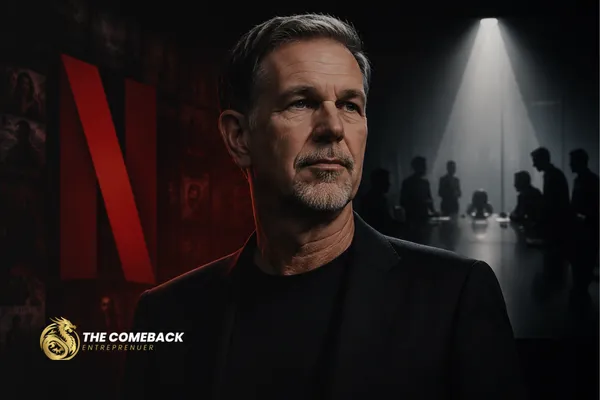
Why Reed Hastings Told the Truth About Netflix Before Anyone Made Him
Comeback Chronicles | THE Top 100 Countdown
#96 Law 5: Truth | Theme: Reality Is The Starting Line
There is a version of this story that gets told at conferences.
Reed Hastings saw streaming coming. He made a bold bet. Netflix survived. The end.
That version is accurate and almost completely useless.
Because it skips the part that actually matters.
The part where Hastings looked at a profitable, growing, beloved business and told his team it would not last.
Not because the numbers demanded it.
Not because a consultant told him to.
Because he had developed the discipline to see what was actually happening instead of what he wanted to be happening.
That discipline is rarer than talent. It is rarer than capital. And it is the single biggest separator between operators who rebuild and operators who stall.
This is the story of how one entrepreneur turned clarity into a competitive weapon, and what that means for the business you are building right now.
The Business That Was Working Too Well To Question
In the early 2000s, Netflix had everything an operator wants.
A growing subscriber base. A model customers loved. A competitor in Blockbuster that was making the classic mistake of protecting its fee structure instead of serving its customers.
Netflix was winning.
And that is exactly when most businesses stop asking hard questions.
When the revenue is climbing, when the reviews are positive, when the industry is validating your model, the last thing any sane person wants to do is sit down and write a list of reasons why everything they built could fail.
But Hastings was already doing it.
Not because he was pessimistic.
Because he understood something that most operators only learn after a crisis forces them to:
The time to face a hard truth is always before the market makes facing it mandatory.
He could see that bandwidth was increasing. He could see that consumer behavior was shifting. He could see that the format his business was built on, physical media, had a window of relevance that was closing whether he acknowledged it or not.
So he acknowledged it.
And then he started building what came next.
The Big Idea That Changes How You See Your Business
Here is the uncomfortable question underneath this story.
If your business were going to become irrelevant in five years, would you know it right now?
Not from the numbers. The numbers are always the last thing to tell the truth.
From the trajectory. From the market signals. From the conversations your best customers are having that they have not told you about yet.
Most entrepreneurs do not go out of business because they lack talent or effort. They go out of business because they kept telling a story about their situation that was more comfortable than accurate.
That gap between reality and the version of reality you tell yourself is not a character flaw.
It is drift.
And drift compounds invisibly until the day it becomes a crisis.
The Law of Truth says that reality is the starting line of every real comeback.
Not your goals. Not your pitch deck. Not the version of the business you intended to build.
Where you actually are, right now, today, is the only honest starting point for anything that comes next.
The Decision That Looked Like Destruction
In 2011, Netflix made an announcement that the market punished immediately.
Hastings proposed separating the DVD and streaming businesses. The DVD service would become a separate brand called Qwikster. Subscribers would need two accounts. Two separate experiences. Two separate bills.
The backlash was swift and severe.
Netflix lost approximately 800,000 subscribers in a single quarter. The stock dropped dramatically. Commentators wrote the company's obituary. Hastings eventually pulled back the Qwikster branding.
And here is where most people misread the story.
They see the subscriber loss and the stock drop and conclude that Hastings was wrong.
He was not wrong about the strategy.
He made a tactical mistake in execution.
There is a critical difference between a tactical mistake and a strategic truth. Most operators abandon the strategic truth when the tactical mistake creates pain. That is when the drift begins.
Hastings corrected the execution error.
He did not abandon the strategic truth underneath it.
The streaming investment continued. The content investment deepened. The infrastructure for what Netflix was becoming kept being built, even while critics were writing the obituary.
Because he had told himself the truth early enough that no amount of external noise could convince him the truth had changed.
What the Numbers Were Actually Saying
Here is a detail that does not make it into the conference version.
By the time most companies feel the pressure to change, the numbers have been telling the story for months, sometimes years.
The signal is usually there.
The problem is not that operators cannot see it.
The problem is that seeing it requires them to act on it, and acting on it is uncomfortable.
It means admitting that something you built has a ceiling.
It means investing in a future that feels uncertain while the present still feels profitable.
It means telling your team, your investors, and yourself a story that is harder than the one everyone wants to hear.
Most operators choose the comfortable story. Not because they are dishonest. Because comfort is always available and clarity always has a cost.
Hastings chose the cost early.
That is the only reason the return was possible at all.
The Entrepreneur Who Tells the Truth Before the Market Forces It
There is a pattern that runs through the comeback stories of the Top 100 that most people overlook because it is not dramatic.
It is not the pivot. It is not the funding round. It is not the product launch.
It is the moment, usually private, usually uncomfortable, usually completely invisible to anyone watching from the outside, when the operator sits down and writes the true version of their situation.
Not the optimistic version. Not the version they tell their team on Monday morning.
The actual version.
What the numbers are really showing. What the market is really doing. What the business actually needs versus what they have been pretending it needs.
That moment, the moment of choosing clarity over comfort, is where every real comeback begins.
It is not inspiring.
It is not the kind of thing that makes a good conference story.
But it is the thing that makes every other move possible.
Because you cannot build from a starting line you refuse to acknowledge.
How This Law Shows Up In Your Business This Week
The version of this that applies to you is almost certainly not about streaming versus DVDs.
It might be the offer that is not converting the way you told your team it would.
The client relationship you have been calling solid that is quietly showing signs of ending.
The revenue number you have been rounding up in your head for three months.
The hire that is not working but you have been avoiding the conversation about.
The market that is shifting in a direction that your current positioning does not address.
None of these are catastrophes yet.
Which is exactly when they need to be faced.
The truth never gets cheaper to face. It only gets more expensive to avoid.
Here is the move.
Write down one sentence that starts with the words: "The truth about my business right now is..."
Do not edit it. Do not soften it. Do not add context that makes it feel more manageable.
Write the true sentence.
Then write one sentence that starts with: "The next move that reality requires of me is..."
That is your starting line.
That is where the comeback begins.
Not from where you wished you were. Not from where you told everyone you would be by now.
From where you actually are.
The 7-Day Truth Protocol
Day 1: Write the real number. The one you have been rounding up or explaining away. No context. Just the number.
Day 2: Write the real constraint. The sentence starts with "The real constraint is..." Do not soften it.
Day 3: Run the three-sentence audit before you start work. "The real number is ___. The real constraint is ___. The real next move is ___." Complete all three.
Day 4: Make one decision you have been delaying because naming the truth would require you to act on it.
Day 5: Identify one thing you have been calling a temporary problem that may be a structural one. Write the difference in one sentence.
Day 6: Tell one person the truth you named this week. Not for permission. For accountability.
Day 7: Score the week. Did your decisions start from where you actually are, or from where you wish you were?
Three Standards That Protect You From Slipping Back
Standard One: The pre-decision truth sentence. Before any major decision, write: "The truth about this situation is..." Write what comes first. Do not edit it.
Standard Two: The weekly number check. Once per week, look at the three numbers that matter most in your business. Write them down. Do not explain them. Just acknowledge them.
Standard Three: The delay audit. If you have been postponing a decision for more than two weeks, ask yourself honestly: is the delay because you need more information, or because you already have the information and do not want to act on it?
Usually it is the second one.
What Reed Hastings Actually Built
Netflix today is not a DVD company that added streaming.
It is a streaming company that used to send DVDs.
That is not a semantic difference.
That is the entire point.
The company Hastings runs today is not the company he started.
It is what that company became because he refused to protect it from the truth about what the market was requiring of it.
That is the comeback pattern. Not protecting what you built. Building what comes next from an honest account of where you actually are.
Talent is common. Capital can be raised. Timing can be worked around.
But the willingness to face the truth before you are forced to, to pay the cost of clarity before the market extracts a higher price for avoidance, that is rare.
And it is the thing that makes everything else possible.
Comeback Score Snapshot: Reed Hastings #96
Rank: #96 Comeback Score: 81 / 100 Theme: Clarity before crisis. Truth as competitive advantage.
This is not a money score.
It is not net worth or revenue or popularity.
It measures the shape and durability of the comeback.
Starting point and what was available to work with. The lows: subscriber loss, public criticism, stock decline, market skepticism. The highs: whether momentum kept compounding after the hard decisions. The repeatability: whether a system was built that acts on truth rather than defers to comfort. The durability: whether the comeback holds over years, not just quarters.
The Comeback Entrepreneur's Journey: Where Do You Stand?
Every comeback has two journeys.
The outer journey is what happened. What you lost. What you rebuilt.
The inner journey is what shifted. What you finally owned. What standards you enforced when it would have been easier to drift.
Most people study the story.
Operators rebuild the identity first.
That is the difference between inspiration and reversal.
If you want to know where you stand, take the Comeback Challenge.
It is not a personality quiz.
It is a scoreboard.
You will receive a 0 to 100 Comeback Score with a clear breakdown of where you are solid and where drift is quietly costing you momentum.
Takes 5 to 10 minutes. Results saved and emailed. If you qualify, you will see the next step.
